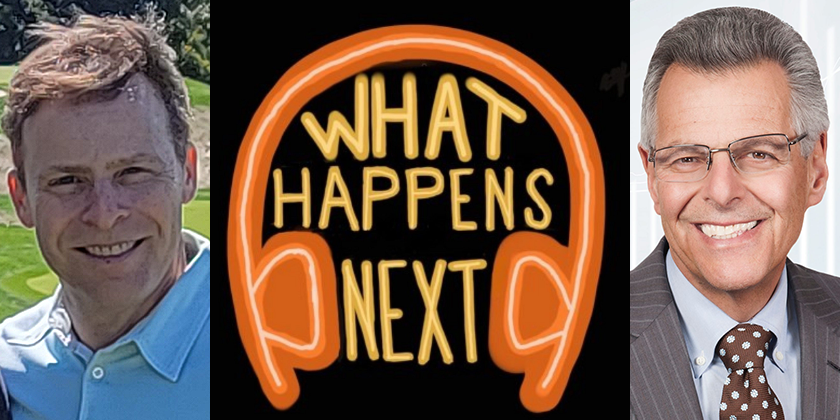
Victor on the ‘What Happens Next’ podcast: “How Should I Invest My Money?”
March 30, 2023
In the News
Victor on the ‘What Happens Next’ podcast: “How Should I Invest My Money?”
Victor was recently a guest on his friend Larry Bernstein’s What Happens Next in 6 Minutes podcast, along with their dear friend and former colleague, Nobel Laureate Myron Scholes. They discussed their views of the essentials, or Golden Rules, of investing. You can listen to the podcast on Spotify or iTunes, or you can read the transcript of the podcast reproduced below. We hope you’ll enjoy the discussion.
Larry Bernstein: Welcome to What Happens Next. My name is Larry Bernstein.
What Happens Next is a podcast which covers economics, finance, politics, and sports. I give the speaker just six minutes to make his opening argument.
Today’s topic is Intelligent Investing.
Our speakers will be Victor Haghani, who is a former Salomon Brothers colleague of mine and one of the founders of Long-Term Capital Management. A decade ago, Victor founded a wealth advisor, Elm Wealth, as an extension of managing his family office.
I endorse Victor’s wealth management strategy that dynamically manages portfolios of low-cost ETFs focused on delivering attractive risk-adjusted, after-tax returns for clients. You will hear directly from Vic about these ideas and you can learn more from his website, ElmWealth.com.
Our second speaker is Myron Scholes, who won the Nobel Prize for his contributions to options theory, which is just a tiny fraction of his many contributions to finance. Myron will speak today about the importance of diversification both across assets and time. Myron was an early advocate of low-cost index funds and believes that you need to dynamically change your investment portfolio when market risk conditions change.
There is much to cover, so buckle up.
I make this podcast to learn, and I offer it free of charge. If you enjoy today’s podcast, please subscribe from our website for weekly emails so that you can continue to enjoy this content.
Ok, let us begin with Victor’s opening six-minute remarks.
Victor Haghani: My perfect portfolio is based on two core ideas. The first is the golden rule of investing. You can’t expect higher returns without taking more risk – return and risk are bound together – but you can get more risk without getting more return, which leads to an important corollary. You shouldn’t expect higher returns for risks that you can eliminate through diversification. The golden rule is enforced by the competitiveness and efficiency of markets. Everyone is looking for return without risk, the proverbial free lunch, and that makes it difficult to find, if at all. The second rule addresses the ‘how much’ question – it’s not enough to know what to invest in, but we also have to decide how much we want to put at risk in those investments. The answer is that we should choose the portfolio which gives us the highest expected risk-adjusted return, where the adjustment we make for risk reflects our own personal degree of risk aversion.
It follows from the second rule that the higher the expected return you can get for a given amount of risk, the more risk you should be willing to take. This second question of investing gets a lot less attention than it deserves, since it’s actually more critical to get right than the first question. Taking too much or too little risk can be much more damaging to your welfare, even if you make good choices of what to invest in.
I’m just finishing a book that mostly addresses this second question, with my partner in Elm Wealth, James White; it’s being published by Wiley and it will be in bookstores in about six months. People who agree on these two ideas and who have similar levels of risk aversion will wind up with similar portfolios – not identical, but close enough to call them the same for practical purposes.
The first rule dictates that your portfolio should be as diversified as possible, which makes low-cost, broad market ETFs the portfolio building blocks of choice. The second rule calls for changing your portfolio as the expected return and risk of assets change over time. It calls for dynamic asset allocation.
For example, if real interest rates go up 1% but equities don’t move at all, doesn’t it make sense all else equal to increase your exposure to bonds and decrease your exposure to equities? Not only is this the rational thing to do, but it also satisfies the need to be responsive and active, but in a disciplined and systematic way that keeps our cognitive biases at bay, stopping us from chasing whatever is hot and dumping whatever is not, usually at just the wrong times.
You’ll want to get your perfect portfolio at the lowest possible price, meaning you want to pay the lowest possible fees and you want it to be as tax-efficient as possible too, and it should take up as little of your precious time and attention as possible. This last point is very important to me, I don’t want my kids to feel that they have to spend a lot of time managing and monitoring their savings. I want them to see that, even though their father was an investment professional, I didn’t spend my time obsessing over investing and trying to beat the market. Isn’t that what financial freedom really is? And so, that’s how I think about the perfect portfolio. I was 45 years old by the time I truly accepted these ideas, first for my family and then for the clients of Elm Wealth, the wealth advisory firm I founded in 2011. If you want to learn more about these two rules and how they can be put into practice, visit me online at elmwealth.com.
LB: Myron, let’s get you into the conversation. Can you describe your role in the development of index funds and passive investing?
Myron Scholes: In 1968, I was graduating from the University of Chicago, and I was asked by Wells Fargo Bank to apply the Markowitz portfolio theory model to allocating money.
I suggested that, instead of an active manager, the future was passive investing in index funds. From there, it took four years before Wells Fargo could get its first client. But everyone thought the idea of indexing was crazy. No one had done passive investing. That was completely foreign to anyone’s thinking at the time. Now, it represents over 30% of the market, and many other investors who claim to be active really hug the index and do not deviate very far from the index at all. It may be over 50% of investing if you really take the active component out of many portfolio manager’s decisions.
LB: What should be the role of index funds in an investor’s portfolio?
MS: It should be the core of anyone’s investment strategy. That should be the starting point and a particularly wonderful way to invest.
LB: Fees are a real drag on investment returns. Vic, Do you think investors should invest with active managers that charge substantial fees?
VH: Fees has gotten a tremendous amount of study in academia and from practitioners. And the overwhelming empirical evidence is that active mutual fund managers underperform index funds on average. And we even have this concept known as Sharpe’s arithmetic, that says that if you take all active managers and put them all together into a portfolio, that that portfolio would be the market portfolio. And so therefore, the return of all active managers combined would equal the return of the market portfolio, less the fees that they charge.
What’s even potentially more detrimental than just the fees is that when you’re choosing active managers. “Well, if somebody has a good track record, I’m going to invest in them.” And when somebody starts to have a bad track record, they pull the money out. So, this return chasing winds up resulting in investors getting even worse returns then the returns of the funds themselves, this divergence between investor returns versus fund returns. Investors can be doing much worse because they come in and go out at the wrong time in general.
The Cathie Woods Ark ETF is the poster child for this. Since she started back in 2014, the ETF that she runs might now be up 50%, but investors have lost billions of dollars because they got in after it had done well and now it’s down 70 or 80%.
When we pay more for something, we expect that we’re getting something better, and we normally do. A Bentley is a lot more expensive than a Chevy, and sure enough, Bentley is just a better car than a $30,000 Chevy, but investment fees are not really like that.
LB: Next question for Vic: Most wealth managers and mutual funds charge investors around 1 percent, but you only charge 12 basis points. How can you charge clients such a small fee?
VH: 12 basis points, we think it’s the appropriate level to charge for managing a diversified portfolio of assets in a sensible way. We use technology to deliver this effectively. What makes fees high is when you need to hire so-called experts to manage individual stock portfolios. Also in the wealth management business, there’s a lot of concierge services so it just winds up being a lot more expensive.
To the extent that people can unbundle the services that they need from actual investment management and portfolio management, they’re better off.
LB: Vic, you mentioned that you use a dynamic asset allocation model so that if interest rates go up by 1% and equities are unchanged that you buy more bonds and sell equities. Tell us about Elm’s model and your implementation of it.
VH: We think that markets are very efficient and so we don’t believe in individual stock picking, but we do think that it makes sense to change your asset allocation over time as interest rates and equity market risk premium change. And that is not inconsistent with the belief in efficient markets, that interest rates do change is not some market inefficiency. And the same goes with equity market risk premium, that stocks can sometimes offer higher or lower long-term expected returns, is something that makes a lot of sense. The world changes, investors are different than each other and levels of risk aversion change over time. Investors who have flexibility should change their asset allocation over time and that will generate better risk adjusted returns. The way that we do it in practice is really simple.
For equity markets, we use the cyclically adjusted earnings yield as an estimate of the long-term real return that we can expect to earn on equities. And we compare that to the safe asset real return, which is the yield on TIPS, inflation protected bonds issued by the US Treasury. And that difference between TIPS yield and the earnings yield of the broad equity markets is our estimate of the risk premium offered by each big equity market in the world.
We also make an adjustment for the changing degree of riskiness of each of these big equity markets. We use a one-year moving average momentum metric to manage the risk of the portfolio. So, in late 2021, we reduced allocations to equities by quite a bit because equities became more risky, interest rates were going up, equities had negative momentum, market risk was higher. And we reduced exposures then which turned out to be a reasonable thing to do. It’s all transparent rules based, which allows us to charge really low fees. Investors know what to expect because they know what the rules are that we’re using. And we also do tax harvesting and we pay a lot of attention to the ETFs that we use to keep costs down. The average expense ratio of all the ETFs we use tends to be seven or eight basis points.
LB: Myron, do you think passive investors should rebalance their portfolios over time?
MS: A passive investment or an index fund is really an active investment. If risks change, then staying exactly at a benchmark and not trying to adjust your risks is not the best investment strategy. Because our objective is to maximize our wealth subject to risk constraints. The investor doesn’t just want to buy and hold, the investor wants to increase wealth.
LB: You recommend focusing on compounded returns and not average returns. What does that mean and what is its relevance to passive investing?
MS: The index fund or a passive investment portfolio is a starting point. It is a static one period allocation. And every investor wants to increase their compound return. And when we move from a one period average return model to a compound return model, then we have to take account of risk. Risk is a very important component of the growth of your portfolio.
The compound return is less than the average return because of volatility.
LB: Let me give an example. Let’s say you make a positive return of 100% in the first period and lose 100% in the second period. You start with a 100, you have 200 after the first period, and zero at the end of the second period. In the average return is zero return which is the average of plus 100 and negative 100, but the reality is your bust.
MS: Volatility reduces compound return for every level of risk. If one is able to do dynamic asset allocation and keep risk at target that will increase your compound return. That’s what I’ve called, time diversification. And I think time diversification is more important than cross-sectional diversification.
LB: So let me simplify for our audience what you are saying. When most financial advisors speak about the benefits of diversification, they are talking about asset diversification by making different investments: US stocks, foreign stocks, US bonds, foreign bonds, real estate, hedge funds, whatever. And it is true that some risks can be diversified, but all of them are invested at the same time. So, if there is some extraordinary event like a pandemic, all risky assets will fall in value simultaneously because the pandemic undermines the value of nearly everything from an office building in Tokyo to a restaurant in Mumbai.
Myron, you have been a big advocate of the benefits of time diversification. And what you mean by that is that you want to take similar scaled risks for each time period.
If you want to save for your retirement in 25 years, you should take similar amounts of risk for each of those 25 years, so that you can diversify the risk from any one particularly bad period. You do not want to lose most of your money in one catastrophic risky period.
MS: What’s really important are the tails that’s suffering the big losses or missing the big gains. So, risk is really the tails. It’s trying to achieve larger great returns, or it’s trying to avoid great losses. And so, the tails are everything.
And unfortunately, in life, the normal distribution or the idea of mean variance doesn’t include the fact that distributions are really changing all the time, or that risk is changing, and risk management is very important.
It also assumes distributions are normal, but it doesn’t assume that the distributions might have fatter tails at times or might be skewed and are changing all the time. And so, that has to be taken into account in any dynamic risk management strategy that will enhance compound returns. The average doesn’t take account of volatility.
LB: Let me repeat what you are saying. If you are investing for the long run to maximize your wealth, you need to avoid big losses and you need to participate in the big gains. This is where all the major price action comes from.
The second concept is that the level of risk in the market varies each day, so that means you should change your portfolio composition to keep your risk constant. To get time diversification, you need to take around the same amount of risk each period, so you need to adjust your portfolio based on tomorrow’s expected risk.
Myron has been a big advocate of benefitting from time diversification. Vic, how do you think about its application to the asset allocation decision?
VH: It’s a really big contribution that he’s made to focus on time diversification.
Time diversification has a lot to do with maximizing risk adjusted return over time. And we’re believers in the idea of time diversification. We use a risk metric to change our asset allocation, so when the markets become riskier, we reduce exposure and try to keep a more even amount of variability over time, which is exactly what Myron is a proponent of. It’s spot on.
LB: Vic, I want to contrast your dynamic investment portfolio approach relative to what other investment managers are doing. The most common method is something called a 60/40 portfolio allocation between stocks and bonds. This is a product offered by money managers where they put 60% of your portfolio in stocks and 40% in bonds, and then monthly or quarterly, they readjust the portfolios when it’s out of whack. What do you think of that 60/40 strategy?
VH: The one thing it really has going for it is simplicity. The 60/40 portfolio is going to make sense every once in a while when the expected return and risk of stocks and bonds is approximately such as to make sense of a 60/40 allocation for you given your degree of risk aversion.
The better thing to do is make your portfolio be consistent with the expected return and the risk that the market is offering for risky assets, combined with your own personal level of risk aversion, and let that change in a systematic way over time, keeping an eye on fees and taxes.
LB: Myron, what do you think of the 60/40 portfolio recommendation?
MS: People say 60% of your assets should be in equity, 40% in bonds, which I guess is a level of average risk. The problem that I see with a 60/40 strategy is essentially that it doesn’t tell you how to be dynamic. It doesn’t tell you how to adjust.
It reminds me, my first wife who always wanted us to have cushions on our couches. And I said, “Okay, we have cushions on the couch.” But I tried to sit on the couch to use the cushion. No, I couldn’t sit on the couch to use the cushion. So I ask, “What good is the cushion? If we have a cushion and we have a reserve, how do we use the reserve?” And passive management is using the reserve.
Why should I just have the cushion all the time without ever sitting on the couch? And that’s a really important problem. So, there’s myriad issues with that 60/40 strategy in that regard.
LB: Myron, in our house my wife has five pillows on my side of the bed, and I don’t see the point of that either. Let me apply the cushion metaphor to the 60/40 portfolio allocation. Having bonds is like having a reserve to buy stocks after equities fall in price, but we always keep the cash in reserve and never use any more than the allocated extra buying power.
Andre Schleifer has written papers that wealth advisors are value add because they encourage individuals to invest in the stock market, And that otherwise, investors would be too cautious and would hold their money in cash and earn a lower long-term return because of their risk aversion.
Vic, what do you think of the benefit of a wealth advisor that charges 1% that encourages those individuals to invest in equities?
VH: I think the general idea is correct. Vanguard has coined the term ‘Advisor Alpha’ to quantify the idea that having a human advisor between you and your investment decisions can really result in much better portfolio performance over time by getting the asset allocation more correct and from stopping you from doing things. 100 basis points is just way too much for that. Maybe 10 or 12 basis points.
LB: Myron, one of the things I don’t understand is why there’s such a variation in investment management recommendations to the public. Some people encourage using wealth managers, some people encourage using active funds, some people encourage use of private equity. Why are there such different investment recommendations that are often contradictory?
MS: There’s a tremendous amount of data mining. We look at the past. And you can educate people, but if you haven’t experienced something, you completely forget it. I think experience is a great teacher and it’s one of the great things about life, is that all our lives are inductive. We look at the past data and we build models from the past data. So induction or data mining is pernicious. People look at the past, what has worked, that builds their intuition.
If you have theory, then you can add to theory by looking at experience. That’s terrific – but a lot of people take their experience and then they ignore theory.
When I first learned to golf, as Victor knows, I read 150 books on golf, I figured out that I was going to be a tremendous expert because I knew from the theory of how to play golf, how good I would be. And Larry, you know my golf game.
LB: Yeah, I know your game. It isn’t pretty.
MS: The problem is that I got on the course and even though I knew all the theory, my game was so bad relative to theory.
We data mine, we take a subset of reality, and we extrapolate from that. All the information that investors use or in which they think they can make money themselves are always subject to destruction because as you run through time, we find that there’s errors in the model. And as people find errors in the model, they reverse engineer the errors in people’s models and they game against them.
They figure out ways to game against it. The system is dynamic. Everything changes.
LB: These past two years have seen some ridiculous investment behavior with the SPAC craze and the surge in the valuation of meme stocks like GameStop. Do you incorporate seemingly misvalued assets in your portfolio management?
VH: Gene Fama is the biggest proponent of efficient markets. I think that he makes a really great point, there’s just all this stuff that looks totally inefficient and crazy, but it’s really hard to make money from it. That’s the test. I mean, it’s not a test to be able to say this looks ridiculous. The test is, is it easy to make money from it? And I just think that it’s really, really hard to make money from market inefficiency.
Markets are efficient enough that I don’t want to try to benefit from their limited inefficiencies, and at Elm we take it that markets are pretty efficient.
LB: Myron, you won the Nobel Prize for your work with Fischer Black that created the Black-Scholes options pricing model. Some critics complain that the assumptions in your model do not match the real world. One example is the assumption that stock returns have constant volatility over time.
MS: When Fischer and I initially built the technology, we used a theory to replicate an option by a combination of a bond and a risky asset. We also had the idea of changing volatilities but we could not get a closed form solution. In other words, a simple formula you can put in Excel.
Fischer and I decided, “Let’s make some assumptions, okay? Let’s assume the risk free rate is constant. Let’s assume the volatility is constant. Let’s assume that there’s no dividends.” Then we could get a closed-form solution.
So that’s a model. And a model is an incomplete description of reality. Basically, the model has errors to it. That’s by definition what a model is because every model is an incomplete description of reality, even though the theory was exact.
LB: Let’s talk taxes. Taxes are drag on the portfolio performance. Vic, how can investors be tax efficient?
VH: I think that taxes are a first order consideration in how you invest. You want to look at every investment that you’re making on an after-tax basis.
Equities are very tax efficient. You tend to get a lot of deferral, and you get long-term capital gains treatment. Then there’s tax loss harvesting that feels like a low-hanging fruit that most people should avail themselves of.
And individuals wind up in a situation where they have some small set of investments that are very appreciated. They got lucky and they’re up 10x or and they represent 50 or 70% of somebody’s portfolio. In those cases, you have to make decisions about, do I realize some gains, pay some tax and get into a more diversified portfolio versus holding onto this highly appreciated asset with the idea that maybe someday I’ll leave it in my estate, and I’ll get a step-up basis if the step-up basis rules don’t change? Or I just defer the tax for as long as possible or maybe I’m in a high tax state and I plan to retire to Florida, and so I say I’m going to hold it for another five years and then when I move to Florida, I’ll realize the gain.
Having to put a price on the risk of having a less diversified portfolio, having more risk than you want. And what we’ve found is that for highly-appreciated assets that represent more than 50% of your total portfolio, it usually makes sense to pair those back and get more diversified – but, if you have something that represents 2% or 3% of your portfolio and is not having a big impact on your overall portfolio risk, you can leave it there and decide what to do with it in the future.
You might also decide to give it away in charitable giving and get the deduction on the market value and never have to pay that capital gain. Taxes are really, really important.
LB: Myron, when should we sell our winners and recognize income for tax purposes?
MS: The government is our partner. If I can make abnormal returns, then I can make 12% and the government’s going to take 6%. I’m better off paying the government 6% than making nothing. You have to be rational. Our object is to maximize our expected compound return after tax.
We have to be dynamic in our asset allocation to maximize our lifetime consumption, which includes not only our own consumption but the consumption of others.
A lot of investors incur taxes as they’re adjusting their portfolio because their circumstances changed.
LB: Let’s assume that you’re a wealthy taxpayer living in a high tax state at the 50% tax rate. If that taxpayer invests in a hedge fund with a 2% management fee and a 20% incentives fee. Under current tax law, the 2% management fee would not be tax deductible. Let’s assume they have a gross return before fees of 10%. The total fees are 3.6% and the taxes would be an additional 4.2%, so the investor only gets a 2.2% after-tax return.
Vic, what do you think of the after-tax economics for a hedge fund investment?
VH: I don’t think there’s anything for me to say, is there? I don’t think these vehicles make sense for highly-taxed, affluent US investors.
LB: Next question is on international diversification. Right now, we’ve had this period where US equities have done so well and we have people like Warren Buffett just telling people, “Put all your equity exposure into the S&P 500. That’s good enough.” Myron, What do you think about international diversification?
MS: Obviously, international diversification reduces idiosyncratic risk. We’re part of a global world, if you just hold assets in the S&P 500, then you are not as diversified.
The world is not only the United States or assets in the S&P 500. The world includes China, the world includes Japan, the world includes Europe. The world includes a tremendous amount of other investment opportunities and why preclude ourselves from adding them into the equilibrium portfolio?
There are benefits, obviously, through diversification and there’s myriad ways to achieve this diversification very inexpensively now. And so, investors should include that in their portfolio.
LB: Vic, in the 1990s we both worked in Salomon Brothers’ Tokyo Proprietary Trading Department. I was flabbergasted by how high the Price to Earnings ratios were in Japan at that time and how low the expected equity returns were available to investors. Americans had little exposure to the Japanese stock market, and almost all Japanese equities were then owned by Japanese individuals.
And I said to myself at the time, “It’s a big world out there. I don’t need to own these Japanese stocks. I’ll leave that for the Japanese.” How has that experience shaped your views on international diversification?
VH: When I designed Elm Wealth, the Japanese experience was in my thinking – and not only does the Japanese experience make me want to be eyes open about what I’m investing in, rather than just purely market cap weighted, I wanted to be forward looking.
Different big markets can offer very meager or sometimes very attractive long-term expected returns, and we should be able to avail ourselves of everything that’s happening in the world. I’m a strong believer in international diversification.
That doesn’t mean that you always want to have a lot of non-US equities. It just means that you want to be looking at the whole world to build your portfolio and not just invest in my home market because it’s my home market.
LB: Ibbotson analyzed 120 years of financial returns for stocks and bonds. Myron, what do you think of the past 120 years as a predictor for the future and whether stocks will continue to outperform other assets?
MS: We think of the return on equities as having a premium over the return on safe assets. I expect to earn a higher return on investing in risky assets that are correlated with my future consumption needs. And that’s basic theory.
Expectations, however, are different from realizations. This is an interesting argument in finance that if I have a long horizon, I should be in equities and not in cash or bonds. Okay? That’s the argument. By investing in equities, I’m virtually certain to outperform investing in bonds or cash over this long horizon period. And then you say, “Virtually certain? Wow, that’s great.” If I can invest in stock over this 20-year period, there’s some chance that if I keep my money in stocks, I could lose 60% or 70% of my money. So, if someone is going to make it virtually certain, it’s not the mean that counts, it’s the distribution around the mean that counts. What’s the shortfall going to be? That’s what you want to ensure against in life. It’s the shortfall. Not that I’m going to on average outperform someone. When is a shortfall going to occur? What am I going to do if the shortfall does occur? Can I stay in the game for 20 years? Those are important questions.
So, it means what risk you take and how you dynamically adjust your risk is a crucial aspect.
LB: Vic, how does the Ibbotson’s 120-year historical analysis shape your thinking about investing in equities for the long run?
VH: I would say very little for two reasons. First, 120 years is actually not that much data for trying to estimate a process that itself is moving around and where each year equities have 18% variability. 120 years is just not that long even if the world didn’t change over that period and we were just trying to estimate something like a coin flip out of it. The more important thing is that we need to look prospectively into the future.
If we’re going to buy a 10-year bond, we just need to look at the yield of that bond to know what return we should expect over the next 10 years from owning that bond. It’s called yield to maturity. We don’t care what was the return on bonds over the last 100 years because we just care about what its yield is today, not what the return was.
And the same goes for equities. Like the fact that equities were trading at a P/E of 10 at many times in the first half of the 20th century means that their returns were going to be pretty high for the next 50 years. We need to look at what’s the P/E today. We need to be looking into the future, looking at cash flows, looking at promised yields on bonds to make our asset allocation decisions. We should make our decisions with what the markets are offering us today, not what the returns have been in the past. We need to be looking to the future, not in the rearview mirror to do our asset allocation. And that’s why our asset allocation should change over time, because what the market offers is changing over time.
LB: How do you determine how to allocate between stocks, bonds, and other assets in your Elm portfolio model?
VH: The ideal portfolio is an individual specific choice depending on your degree of risk tolerance for a given amount of expected excess return offered by risky assets. You’re going to want to have a different amount of exposure than somebody else with a different degree of risk aversion. At Elm, we have a baseline product that we offer to people. And if that doesn’t really match their risk tolerance, then Elm can make their total portfolio less risky, like having more fixed income. Also, we do customized portfolios for people to their level of risk aversion.
We want everything that we put into people’s portfolios to be low-cost, diversified, and big asset classes where we can have some idea of measuring the expected returns in the future. We tend to stay away from things that are not liquid.
We recognize that people will be attracted to other kinds of investments. And we just accept that that’s not going to be part of what we’re doing for them, and they need to do that on the side.
LB: Vic, what assets are the building blocks in portfolio design, and how do you implement that strategy for your Elm clients?
VH: We have a really simple offering, for US investors, we open an account at Fidelity or Schwab and we manage their account for them. They can put money in, take money out whenever they want, they get statements directly from Fidelity or the other brokers – it’s their account and it’s in their name, and anytime they want to remove us, that’s it, they just remove us and everything stays the same, there’s no realizations. We rebalance their portfolios on a weekly basis, moving towards our ever-changing targets, where our targets are evolving with changes in the expected return and riskiness of about 10 major asset classes.
LB: Tell us about some of the free tools that you have on your website to help investors figure out their own risk tolerance and other key ingredients to portfolio design?
VH: We have a bunch of interactive tools on our website, elmwealth.com. We have apps that can give you the historical returns on a daily basis of our different strategies that you can download and analyze. We have historical asset allocation that shows our different strategies over time.
Our most popular app on our website is a coin-flipping game where you can flip a coin which is biased 60/40 and see how you manage the risk of that over time or over a number of flips. And that’s hugely popular. Sometimes we get 100 playing that in a day. And that’s really very educational for people to just get a sense for what is randomness and what is it like to have an edge of 60/40 and how do I manage something like that over time.
We also have some tools that help with tax decisions like we were talking about earlier. If you have an appreciated asset and you’re trying to figure out what’s the optimal amount to reduce and pay taxes on today, you can put in expectations of future tax rates and come to useful answers.
And a lifetime consumption and portfolio choice tool which helps people to think about wealth and longevity and optimal investment and spending policies. It allows people to make better decisions about how much risk to take in their portfolios and what kind of spending policy makes sense.
LB: What are you optimistic about the field of finance?
MS: If I just got out of university at this moment, I would go into finance again. Finance is uncertainty. Uncertainty is the cornerstone of all our lives. It’s the cornerstone of everything we do, and understanding uncertainty, or how to think about uncertainty, is just unbelievably fascinating. It’s been fascinating for philosophers.
I’m so excited about uncertainty and how finance adds to it. The greatest investment you can do is keep educating your brain, keep building your human capital and try to preserve it. Eating the correct way, living life the correct way, loving the correct way, physical exercise.
And then types of investment are always changing. We’re always learning about how to make better investments, and that’s what’s exciting. If the world was static, I’d be bored. If the world is dynamic, I enjoy it. And the information set is so large, it allows us to keep learning and keep growing, because there’s so much learning that we still have ahead.
LB: Myron, what is unusual about your optimism is that it runs counter to risk aversion in finance theory. Normally, uncertainty makes us scared. Uncertainty in asset returns encourages us to hold more cash and fewer risky assets. Uncertainty is viewed as a negative, but you just said that uncertainty was a beautiful thing.
This reminds me of an episode of the TV show The Twilight Zone. Here’s the plot of the relevant show.
A guy dies. He wakes up wearing a tuxedo in a casino. He is thrilled because he loves casinos. He walks over to the roulette wheel and bets on red. It’s red and he wins. Then, he bets on 12. It’s 12. So, he moves away from the roulette wheel a winner and heads over to the bar where a pretty girl is seated. He orders a drink, and he makes a move on the girl, and he gets the girl.
This goes on day after day. He sees the manager. “Hey pit boss, do you have a second? I want to talk to you.” And he says, “Sure, what’s up?”
“Listen, is it possible that you can change things around here, so I don’t win every bet. If I bet on red, how about it comes up black every so often? I bet on 12, it comes up 14. I go to the bar, I try to pick up the girl, I’m a little fresh. She throws the drink in my face. Okay? How about a little bit of that? Winning every time, it’s no good. Can you throw me a bone.” This is how I think heaven should be. And the pit boss says, “who told you this was heaven?”
MS: That’s correct. This is a story I always thought about.
LB: Vic, what are you optimistic about?
VH: People have been making better financial decisions over time. If you go back to the 1950s or 1960s, there’s a Fed study that found that the median number of stocks that were held in an individual’s brokerage account was two. Back then, people just didn’t get diversification at all.
Today, the use of broadly-diversified index funds has become so prevalent among individual investors. We’re just moving in the right direction with regard to people making better financial decisions for themselves. Now, there’s bumps along the way – the whole meme stock thing in 2020 and 2021 was disheartening for me – but overall, we’re on a great trajectory for people making better and better financial decisions, people being more disciplined in what they’re doing, and new technologies that are helping people to make better decisions with lower fees. What we do at Elm, we couldn’t have done 20 years ago because of technology, because of the low-cost broad index funds that are covering all major asset classes. I’m optimistic on better financial outcomes for more people as we go through time.
LB: Thanks to Vic and Myron for joining us today. If the ideas we just discussed resonate with you, visit elmwealth.com where you can find a lot of relevant research and tools, and where you can get in touch with Vic and his team for a deeper dive.